

You have three assignments due this week, an exam coming up, and barely enough time to catch up on your lecture notes. You search online for homework assistance, find a website promising quick solutions, and feel tempted to place an order immediately. But how do you know whether the website is trustworthy?
Finding reliable homework help websites can be difficult when you’re already stressed about deadlines. Some services provide useful explanations and academic guidance, while others may hide fees, make unrealistic promises, or fail to deliver what they advertise.
Before sharing your personal information or paying for a service, take a few minutes to check its credibility. Learning how to spot homework help website scams can save you money, protect your information, and help you find support that genuinely benefits your studies.
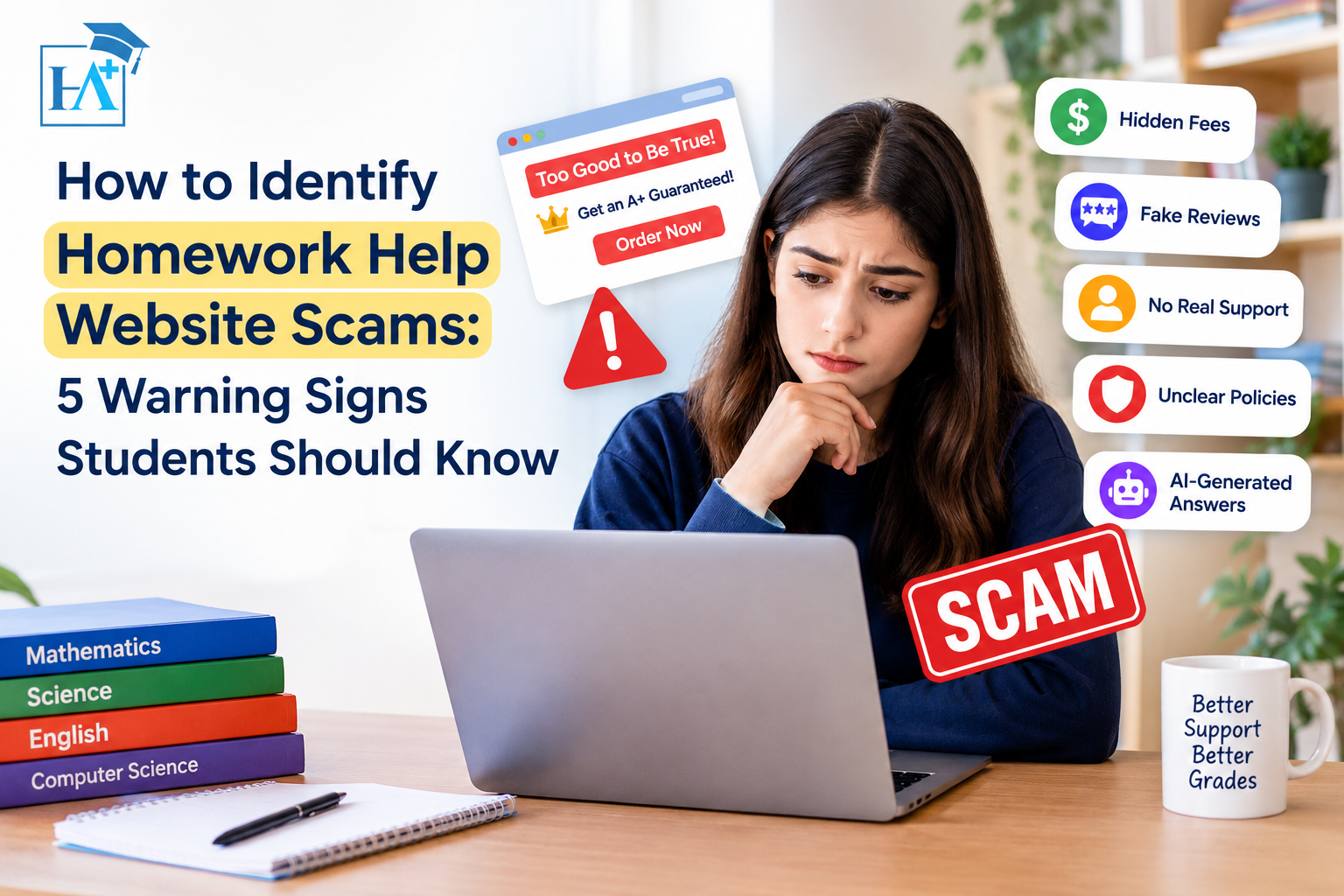
Here are five warning signs to look for before choosing a homework help service.
1. Hidden Prices and Unexpected Charges
One of the first things to check when visiting a homework help website is its pricing policy. You should understand how the service charges you, what is included, and whether additional fees may apply before making a payment.
Some questionable websites advertise extremely low prices to attract students. Once you submit your assignment details, however, the quoted amount may increase because of unexplained charges, urgent delivery fees, or additional payments for services you thought were already included.
What should you watch for?
Look out for these warning signs:
- The website refuses to provide a price estimate before you share personal information.
- Additional charges appear only after you have paid.
- Customer support pressures you to upgrade to a more expensive package.
- The refund policy is difficult to find or uses unclear language.
- You are asked to make another payment to release work you have already purchased.
For example, imagine a website advertises an affordable assignment solution. After you pay, the representative tells you that you must pay extra for quality checking or delivery. If these charges were never explained beforehand, you have a good reason to question the service.
How to protect yourself
Read the pricing information and refund terms carefully. Ask customer support to explain any unclear charges in writing, and save screenshots of the quoted price and payment confirmation.
A trustworthy homework help service should explain its pricing structure clearly, even if the final cost depends on the subject, complexity, or deadline.
2. Unrealistic Promises and Guaranteed Grades
When deadlines approach, promises such as “Get an A+ on every assignment” or “Guaranteed perfect grades” can sound appealing. However, no homework help website can control your professor’s grading decisions or guarantee a particular academic result.
Be cautious when a service claims that every answer is perfect, every assignment will receive full marks, or difficult coursework can be completed instantly without reviewing the requirements.
Why these promises are concerning
Academic assignments are evaluated according to different rubrics, course expectations, and instructor requirements. Even a well-prepared explanation may need adjustments to match your professor’s instructions.
Unrealistic promises can also distract you from what matters most: understanding the subject and checking whether the service can provide appropriate support.
Other warning signs include:
- Claims of guaranteed grades regardless of the assignment.
- Promises of instant solutions for every subject and difficulty level.
- No explanation of how answers are prepared or checked.
- Claims that you never need to study or understand the material yourself.
What a reliable service should offer
Look for clear information about the support provided, the expertise of the people delivering it, and the process for asking questions or requesting clarification.
A useful academic service should help you understand difficult concepts, review problem-solving methods, and work through questions more confidently. Avoid any service that encourages you to ignore your university’s academic integrity rules.
3. Fake Reviews and Unverified Expertise
Reviews can help you compare homework help websites, but not every testimonial tells the full story. A website may display glowing customer comments without providing enough information to establish whether those experiences are genuine.
Likewise, a professional-looking website does not automatically mean that its tutors have the subject knowledge needed to help you.
How to recognize suspicious reviews
Before choosing a service, look for patterns rather than relying on one rating.
- Every review uses similar wording and gives the highest possible score.
- Testimonials contain vague statements without describing the actual experience.
- The website provides no information about tutor qualifications or subject expertise.
- Independent reviews repeatedly mention unresolved complaints.
- Customer feedback appears inconsistent across different platforms.
For instance, if you need help with a university-level statistics assignment, a general claim that a website has “the best tutors” is not enough. You want to understand whether the service can connect you with someone familiar with statistics and the concepts covered in your course.
Where should you check?
Search for the company name alongside terms such as “reviews,” “complaints,” and “scam.” Check independent review platforms and student discussions, and pay attention to recent feedback.
A single negative review does not prove that a service is fraudulent. However, repeated complaints about the same issue deserve closer attention.
You can also contact customer support before paying and ask how tutors are selected, what subjects they cover, and how students can request clarification if they do not understand a solution.
4. Poor Communication and Unclear Policies
Imagine you have paid for assignment support, but the deadline is approaching and nobody responds to your messages. You cannot find a clear refund policy, and different representatives give you different answers.
Poor communication does not automatically prove a scam, but it can make resolving problems much harder.
Check these details before placing an order
A reliable homework assistance provider should make it reasonably easy to find information about:
- Contact options: Is there a clear way to contact customer support?
- Service details: Does the website explain what is included?
- Refund and revision policies: Are the conditions available before payment?
- Privacy: Does the company explain how it handles your personal information?
- Delivery expectations: Are deadlines and limitations communicated clearly?
Pay attention to how the support team responds to ordinary questions. If representatives avoid direct answers, become aggressive when you ask about refunds, or pressure you to pay immediately, consider looking elsewhere.
Protect your personal information
Never share your university account password, banking credentials, or verification codes with a homework help provider. Be cautious about uploading documents that contain unnecessary personal details.
Use secure payment methods and review the information requested during registration. A service should not need unrestricted access to your student account simply to explain a homework problem.
If a company threatens to expose your personal information or contact your university to force additional payments, preserve the messages and seek appropriate help. Contact your payment provider if you suspect fraud.
5. AI-Generated Answers Without Proper Explanation
AI tools have made it easier to generate answers quickly, but speed does not always mean accuracy. An answer may sound convincing while containing incorrect calculations, invented references, or explanations that do not match your course requirements.
This is particularly concerning when a website advertises expert academic support but does not clearly explain how its answers are produced.
How to check the quality of a solution
Before relying on an answer, ask yourself:
- Does the explanation follow the method taught in your course?
- Are calculations and intermediate steps included?
- Can you verify the references, facts, or formulas?
- Does the response address every part of the question?
- Can the provider explain a step you do not understand?
For example, a physics solution that gives a final numerical answer without showing the formula, units, or calculations may not help you understand the underlying concept. A detailed explanation makes it easier to identify mistakes and learn how to solve similar questions.
Is a Non AI Homework Helper a better option?
Students who prefer human guidance may look for a Non AI Homework Helper that provides explanations directly from subject experts rather than relying on AI-generated answers alone.
If that is your preference, ask how the service works before placing an order. Check whether you can communicate with a tutor, ask follow-up questions, and receive explanations that address your specific difficulties.
TutorBin presents its service as human-expert academic support, with homework assistance, one-on-one live sessions, and step-by-step solutions. You can explore TutorBin’s homework help services to review the available options and decide whether they suit your learning needs.
As with any provider, review the applicable pricing, service terms, and academic integrity requirements before proceeding. The important thing is to choose support that helps you understand the work rather than simply accepting an answer without checking it.
How to Choose a Trustworthy Homework Help Service
Once you know the warning signs, you can make a more informed decision by following a few simple steps before paying for academic support.
Use this quick checklist
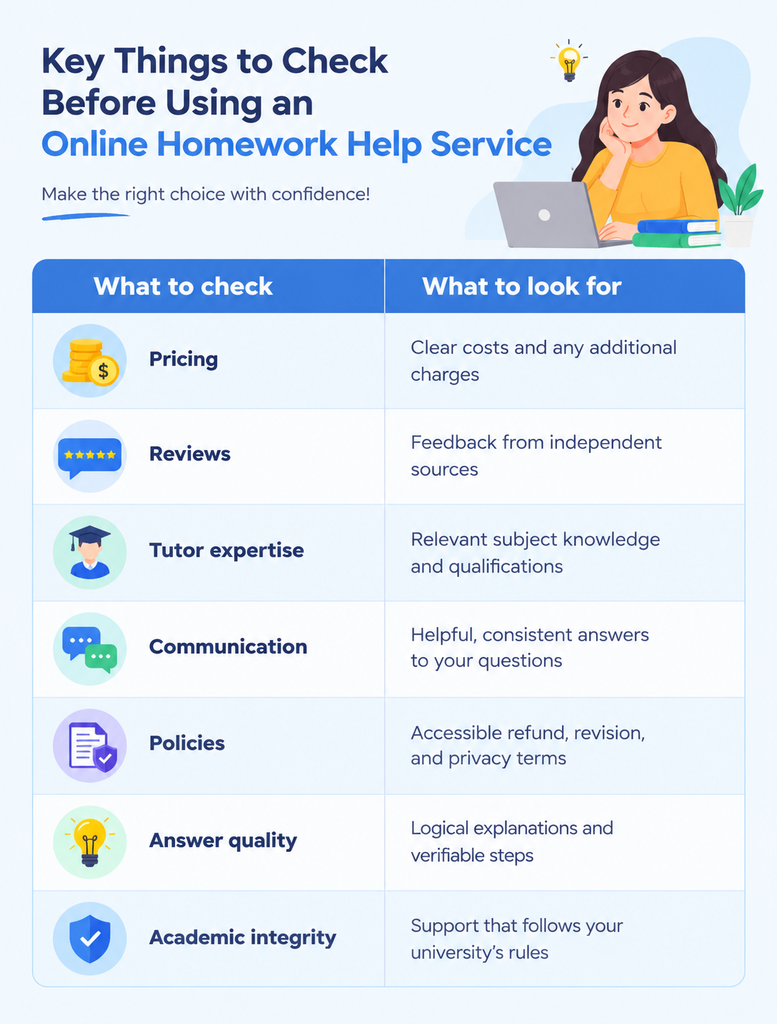
You do not need to investigate every website for hours. Start with the most important details: pricing, independent reviews, communication, and the actual support offered.
If something seems suspicious, pause before making a payment. Compare another provider, ask for clarification, or use your university’s tutoring resources instead.
What if you need help with an urgent assignment?
When students search for “complete my assignment” or “do my homework,” they may be looking for anything from help understanding a difficult question to guidance with a complicated project.
Before choosing a service, identify what you actually need. You might benefit from a tutor who explains a formula, feedback on your draft, help understanding a programming error, or a guided session on an unfamiliar topic.
Choose a provider that explains its services clearly and supports your learning. If you are considering TutorBin, start by reviewing its homework assistance options and checking whether the available support matches your subject, deadline, and course requirements.
Most importantly, follow your university’s academic integrity policy. Use academic support to build your understanding and prepare your own work rather than submitting someone else’s work as your own.
Conclusion
Finding reliable homework help websites starts with asking the right questions. Before paying for a service, check its pricing, reviews, promises, communication, and approach to providing academic support.
The best way to avoid homework scams is to slow down and verify the details, even when a deadline is approaching. Do not let unrealistic guarantees or pressure tactics rush you into a decision.
If you need academic guidance, choose a homework help service that explains its process clearly, respects your privacy, and helps you understand difficult concepts. TutorBin is one option to explore if you prefer support from human subject experts.
Ultimately, the goal is not just to finish an assignment. It is to find dependable support that helps you learn, protect your information, and approach your university coursework with greater confidence.
Frequently Asked Questions
1. How can I spot homework help website scams?
Look for hidden fees, unrealistic grade guarantees, suspicious reviews, poor communication, and unclear information about how answers are prepared. Verify the service independently before paying.
2. Are all homework help websites scams?
No. Some provide legitimate tutoring, explanations, and academic guidance. The key is to evaluate each service’s credibility, policies, expertise, and approach to student learning.
3. How can I check whether a homework help service is legitimate?
Read independent reviews, check the contact and policy pages, confirm pricing, and ask specific questions about the service. Avoid paying if the provider cannot explain important details clearly.
4. Are AI-generated homework answers always accurate?
No. AI-generated answers can contain factual errors, incorrect calculations, or explanations that do not match assignment requirements. Verify important information and make sure you understand the solution.
5. What should I do if a homework help website scams me?
Save payment receipts, messages, screenshots, and order details. Contact your payment provider to ask about dispute options, secure any compromised accounts, and report suspected fraud to the appropriate authorities.